Wednesday, May 19, 2010

Shooting the Tour of California


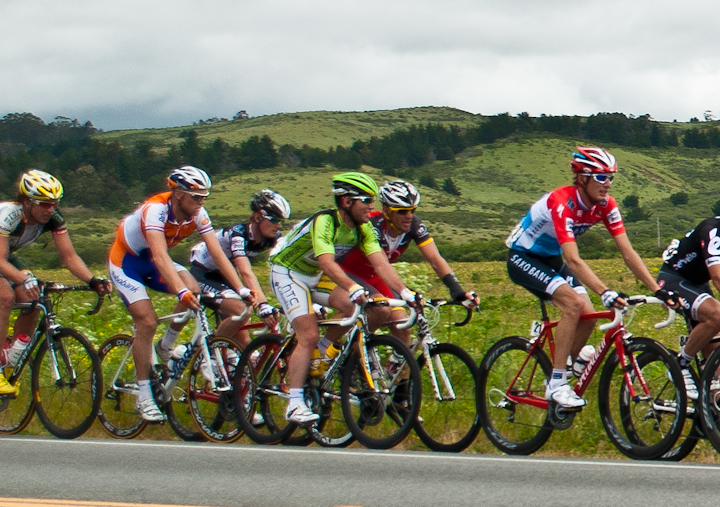
Mark Cavendish in green riding along side Lance Armstrong


Access gives many sports photographers an edge. Courtside in basketball, on the sideline for football or where ever that coveted sweet spot is will give you the best chance of getting a great shot. So I think the Tour of California bike race is different. It comes to me, right through my home town - right down my street. There are no fences to block my shot and no press pass is needed. It's not quite that easy.

The first thing to think about is if you want a particular angle on the riders or a certain background, getting both is difficult. You scout your area days in advance and you run into other photographers doing the same.
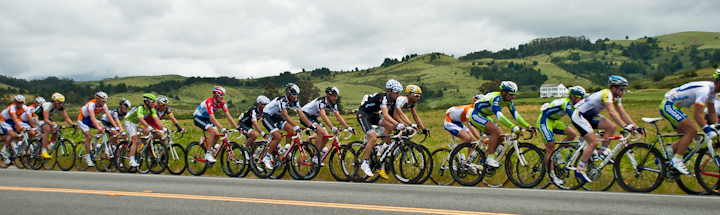
The peleton passes by the historic Johnston House


Then you must consider road closures. The police and the peleton are most unpredictable. The best bet is to get there early and bring some food and a chair.

Research the race and riders. Know their colors. It helps if you can follow the race on your smart phone as they approach. Is there a break-away group? Is there a sprint or feeding station nearby. All these factors may affect if you want a fierce racing shot or one of everyone sitting up, eating and throwing half empty water bottles at you. Then again, they may not.

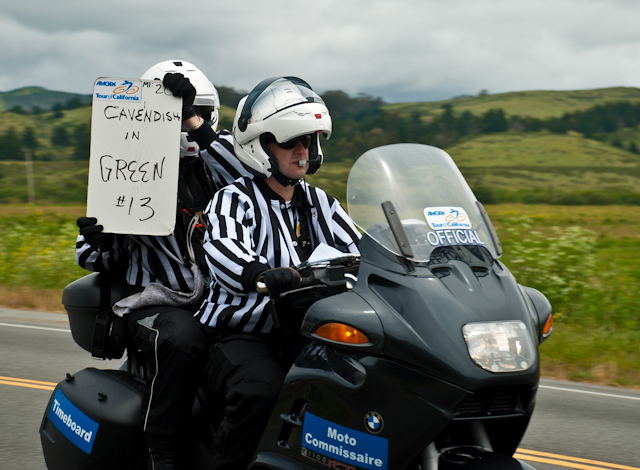
Unless you photograph bikers every weekend, there is no time to practice. If you are smart, you practice by shooting all the support vehicles, press motorcycles and police that go by before the riders. That is not a bad idea because, no sooner that you see the riders approaching, they are on top of you and then they are gone.
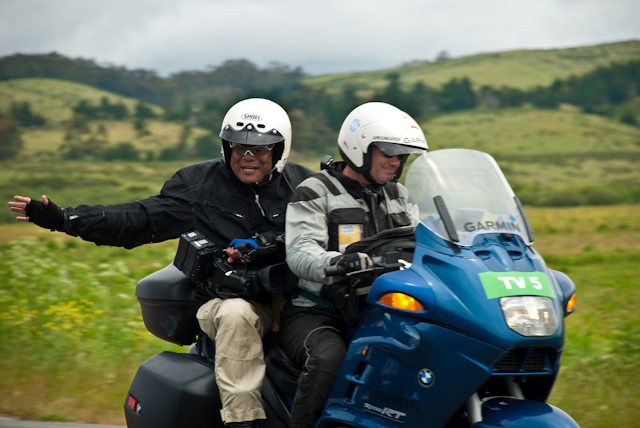


Access helps you get the shot

Keep both eyes open so as not to miss anything, trip over someone else, get in the way or be hit by a vehicle.


Scouting the route, I decided to show something of Half Moon Bay and also try for a shot on the Tunitas Creek hill climb. I tried to get the riders with the green hills and the historic Johnston house in the background and was successful. Are they in focus? Not very. A faster camera would help.

I then jumped in my car and drove up to Woodside where Tunitas Creek crosses Skyline drive hoping to park, walk down the hill and get a shot of each rider's faces showing the pain of the climb.

I was lucky to get a non-muddy parking spot about a half mile from the intersection. The top of this mountain was in the clouds. Water dripped from the trees and down my back as I protected my camera under my coat. A thousand people crowded the intersection, many shivering in biking attire. Bicycles covered every bit of ground that wasn't occupied by spectators. As I approach, the Amgen van drives through saying the riders are one mile away. Holy Moly, I wanted to hike down the road a mile or 2 to get my shots.

I squeezed through to the middle of the street and hightailed it down hill, dodging police on motorcyles and speeding support cars loaded with spare bikes. I found a break in the redwood trees that let in a little bit of light through the fog and took my place along side a dozen other photographers looking for the same shot, and just in time. Balancing on a small mound, a steep slide of mud on one side and the road on the other, I squeezed off a few blurry shots between the other photographers as the peleton roared by.


Lance (second from left) with the peleton out of the fog on Tunitas Creek road. A fellow photographer on the right

That Tunitas Creek climb was nothing for these stellar atheletes. Here, I'm thinking about the Pyrenees in France and how it tests the Tour de France riders. They should be spread out, struggling up the hill, moving relatively slow with pained concentration on their face. Think again.

I scored a few pictures and learned a few lessons. All is good. Maybe, the climb out of San Jose to Modesto will give me those shots I want. Or staking out a corner at a time trial would provide some great opportunities. Those vantage points were more of a commitment than I had time for this year.
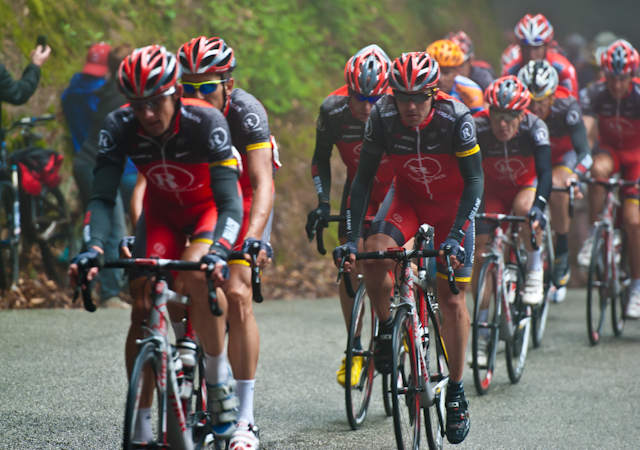

Team Radio Shack on Tunitas Creek road

Saturday, May 15, 2010

Birds on the Coast

The owls of Canada Cove - Stuart Nafey photo


Looking for wildlife to photograph? A recent blog post by Scott Bourne lists his top 7 bird and wildlife photography hotspots in the states.

Reading this article, I realized that many of the birds he mentions to be found in these refuges can also be found here in the San Francisco bay area. According to information provided by the Don Edwards Wildlife Preserve, the bay area has "30,000 acres of wetlands, open water, and upland habitats, are home to at least 800,000 birds at any given time and to millions during peak migration". That link takes you to a comphrehensive list detailing when you might find which birds.

Just a partial list of birds we have spotted here in Half Moon Bay include:

Barn owls
Pacific Great horned owls
Great blue Herons
Cattle egrets
White herons
Green herons
Cormorants
Lesser murres
Oyster catchers
Snowy plovers
Red tailed hawks
Golden eagles
Turkey vultures
Kestrels
Kites
Peregrine falcons
Hooded oreoles
Downy woodpeckers
Acorn woodpeckers

Not to mention all the other sea birds, finches, hummingbirds and other North American varieties. It is a worthy project to document the birds of the bay area.

Tuesday, April 13, 2010

Timing the Sun and Moon

Our ancestors quarried and hauled gargantuan stones many miles to build monuments that could predict where the sun and moon would rise and set. Photographers now days have it a little easier.

The Photographer's Ephemeris is one tool that combines centuries of observed astronomical and gravitational data with Google maps and shows you in exqusite detail where the sun and moon will be directing their light and the corresponding shadows, at any time of the day or night, at any place on earth, even allowing for elevation of the surrounding terrain. Well, maybe not every coordinate on earth, yet. I have not tested it's limits.


Stephen Trainor is the author of this free program. An iPod app will also be available on April 17.

Watching the short tutorials reveals the power of this program. Mark my words, this is something we all will applaud today, take for granted tomorrow and some will actually complain about in the future. Since this will actually save you time and money, Stephen provides a donation link to help maintain the service. Please consider contributing.

Here is the link to his blog or click the picture above. Thank you Stephen, for making my life that much simpler.

Saturday, April 3, 2010

Kite Aerial Photography

Kite Aerial Photography is a technique I am itching to try and this photograph taken by George Lawrence after the 1906 earthquake in San Francisco is inspiring. Someone (at the USGS?) did a great job of creating a zoomable high resolution version.

Monday, March 29, 2010

Golden Hour

Ah, the golden hour, that period of time 1 hour after sunrise and 1 hour before sunset when our ultimate light source filters through the maximum amount of atmosphere. There are only 2 in a day. I took this picture in Bossier City, Louisiana during the evening version. More often then not, I miss the morning occurance. The musician in me refuses to recognize two 7 o'clocks in the same day. I do take advantage if I am forced to rise early, if I must take someone to the airport at 0 dark thirty for instance. I rationalize and balance what I miss by staying up late and developing pictures in the dark of night.


If you want the Golden Gate Bridge to be lit from the city side, you have to be there before noon. If you want to take advantage of that atmospheric phenomenon instead of buying filters or warming it in post production, get there early. This shot was taken at 07:30 am, not too bad. Click on it to get the full effect.

Tuesday, March 23, 2010

Facebook Fan Page

On Facebook? Follow my page for quick news and gallery updates!


Tuesday, March 16, 2010

Why lenses cost so much.

The Canon Library gives you a "How They Do It" tour of a virtual lens factory, showing every step, from raw material to a finished product of producing a 500mm lens.